Celebrating Women in Heritage: Knowledge, Resistance, and the Reframing of Resilience
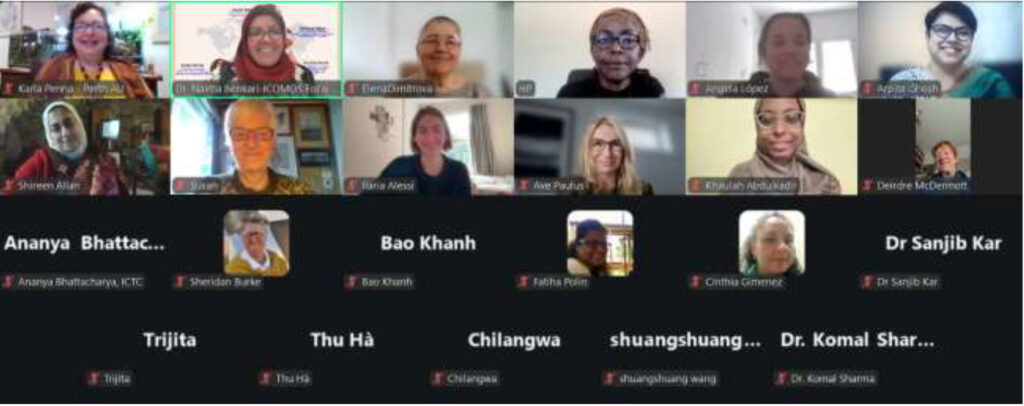
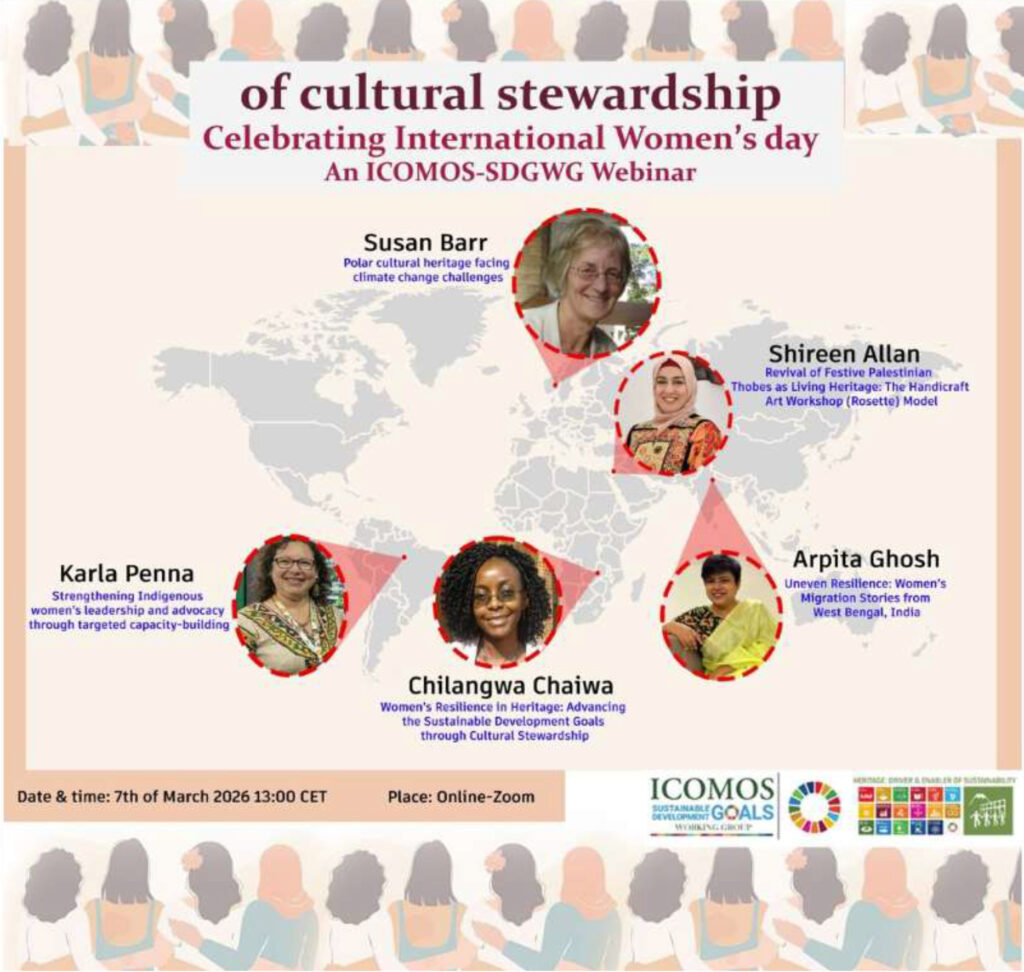
On 7 March, the Task Team 8, SDG5 and Heritage (Gender Equality & Heritage) of the ICOMOS SDG Working Group hosted a webinar celebrating the role of women in heritage and their vital contributions to sustainable development. Organised by Team Task 8, the session brought together practitioners, researchers, and heritage professionals from across the globe to reflect on how women’s knowledge, leadership, and lived experience shape the protection and continuity of cultural heritage. The speakers of this event were: Susan Barr, Shireen Allan, Arpita Ghosh, Chilangwa Chiawa, and Karla Penna.
Rather than focusing solely on celebration, the webinar addressed the often unseen and undervalued labour of women who safeguard heritage in contexts marked by climate change, displacement, conflict, and economic uncertainty. Participants explored how women’s knowledge systems and everyday practices are essential to both heritage survival and the broader ambitions of the United Nations Sustainable Development Goal 5 – Gender Equality.
Opening reflections: acknowledging “voiceless heritage”
The session opened by recognising that women today face unprecedented pressures across both the Global North and the Global South. Facilitators framed the discussion around what they described as “voiceless heritage”: the unrecorded stories, practices, and survival strategies of women navigating environmental instability, conflict, and migration.
This framing set the tone for a conversation that sought to highlight women not only as heritage bearers but also as active agents shaping the cultural and environmental futures of their communities.
Women documenting disappearing heritage
One of the presentations highlighted the urgent challenge of heritage loss in polar regions. Drawing on decades of field experience, the speaker reflected on a career spent documenting historical remains in Arctic and Antarctic landscapes increasingly threatened by melting permafrost and accelerating climate change.
The presentation emphasised that polar heritage, often described as a form of “frozen history”, is rapidly deteriorating. Women’s participation in field science has been critical to documenting these fragile sites before they vanish. The speaker also reflected on the personal challenges of conducting long-term research in extreme environments while balancing family responsibilities, underscoring the persistence and dedication of women researchers in heritage science.
Women as custodians and leaders
Another contribution addressed the central role of women as custodians of heritage across many African contexts. Women sustain rituals, transmit cultural knowledge, and care for landscapes that hold collective memory. Yet despite this foundational role, they often remain excluded from formal decision-making structures within heritage governance.
The discussion emphasised that achieving gender equality in heritage requires moving beyond recognition of women as “informal keepers” of culture. Instead, women must be supported as leaders and decision-makers whose expertise informs policy, conservation strategies, and community development initiatives.
Cultural heritage as resistance
In contexts affected by conflict and displacement, cultural practices can become powerful forms of resilience and resistance. One presentation explored the revival of the Palestinian thob (traditional embroidered dress) as a living archive of identity and memory.
Embroidery traditions passed down through generations of women serve not only as artistic expression but also as a silent language that encodes local histories, landscapes, and cultural belonging. In situations where territory and identity are contested, such practices become vital forms of continuity. At the same time, they can offer pathways for economic empowerment through craft-based livelihoods.
Indigenous knowledge and climate narratives
Another key theme of the webinar focused on Indigenous knowledge systems and their relevance for addressing climate change. A presentation based on collaborative work with Aboriginal communities highlighted how oral histories and cultural practices preserve thousands of years of environmental knowledge.
Participants noted that mainstream environmental narratives often focus on the abstract idea of “saving the planet,” while overlooking the people whose knowledge has enabled communities to survive past climatic cycles. Indigenous women and elders hold crucial knowledge about land stewardship, adaptation strategies, and ecological balance. Protecting this knowledge and ensuring that it informs policy was identified as a critical step toward more inclusive and effective climate action.
Challenging the myth of “compulsory resilience”
A powerful intervention addressed the concept of “compulsory resilience,” referring to the widespread expectation that women should endure hardship without structural support. Research on migrant women in West Bengal demonstrated that what is often described as resilience may in fact reflect forced survival strategies developed in the absence of institutional assistance.
Participants stressed the need to move away from romanticising women’s strength. The exhaustion and emotional toll experienced by women managing displacement, economic precarity, or social marginalisation must be recognised as indicators of systemic gaps rather than individual resilience.
Discussion: authenticity, language, and long-term support
During the open discussion, participants explored several cross-cutting issues. One recurring theme was the tension between commercialisation and authenticity in women’s cultural practices. While craft traditions such as embroidery can provide important economic opportunities, mass production risks diluting their cultural meaning.
Another point raised concerned the accessibility of language used in heritage and development discussions. Technical or academic terminology can unintentionally exclude the very women whose knowledge and lived experience are most valuable. Ensuring that dialogues remain inclusive and community-driven was identified as an important priority.
A call to recognise women as architects of survival
The webinar concluded with a clear message: women are not simply passive victims of global crises. They are key architects of cultural continuity and community survival.
For the ICOMOS SDG Working Group and the SDG5 Task Team, the challenge ahead is to ensure that women’s knowledge, often transmitted through everyday cultural practices, is documented, respected, and integrated into heritage policy and sustainable development strategies.
The session closed with a call for continued collaboration and solidarity, encouraging participants to work together in documenting and amplifying these “voiceless” histories so they can inform more inclusive and resilient futures.