While cultural heritage drives local resilience and identity, it remains nearly invisible within the United Nations 2030 Agenda (explicitly named only in SDG Target 11.4). Consequently, invaluable heritage achievements are omitted from public funding and policy decisions because they lack the structured, results-oriented language used by the UN. To bridge this gap, the ICOMOS Sustainable Development Goals Working Group (SDGWG) launched its regional webinar series. By equipping National Committees (NatComs) with standardized reporting tools, the SDGWG translates raw field data into report-ready evidence, ensuring heritage is integrated into national policy through upcoming UN review cycles and paving the way for a standalone Post-2030 Culture Goal.
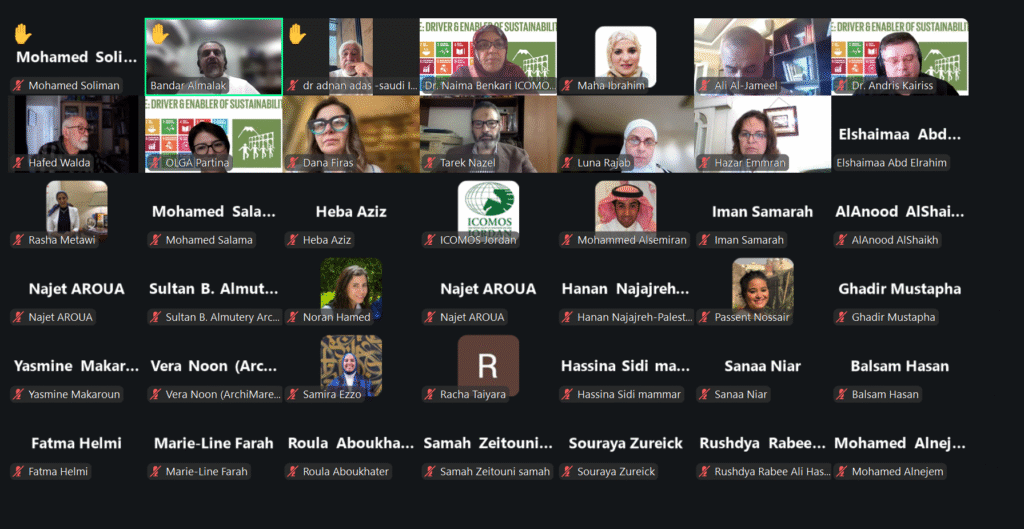
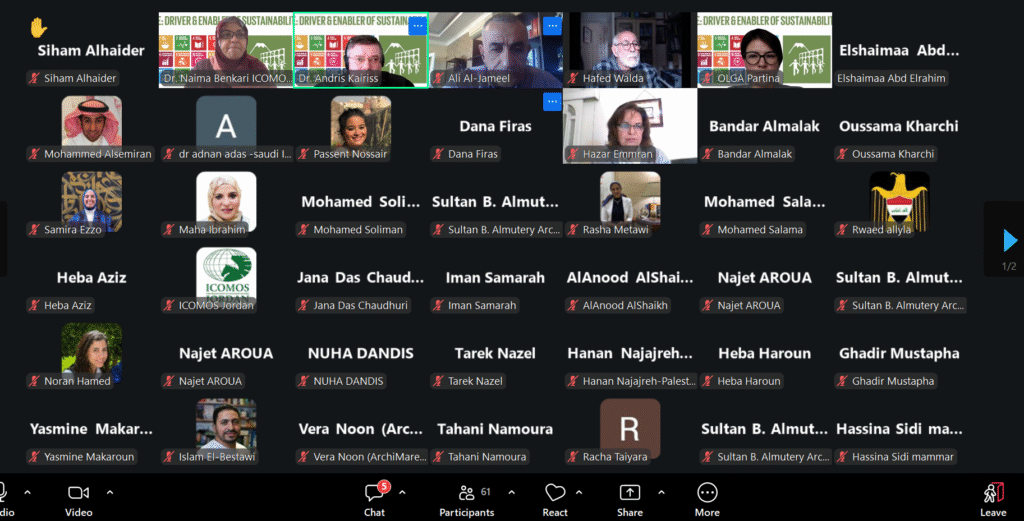
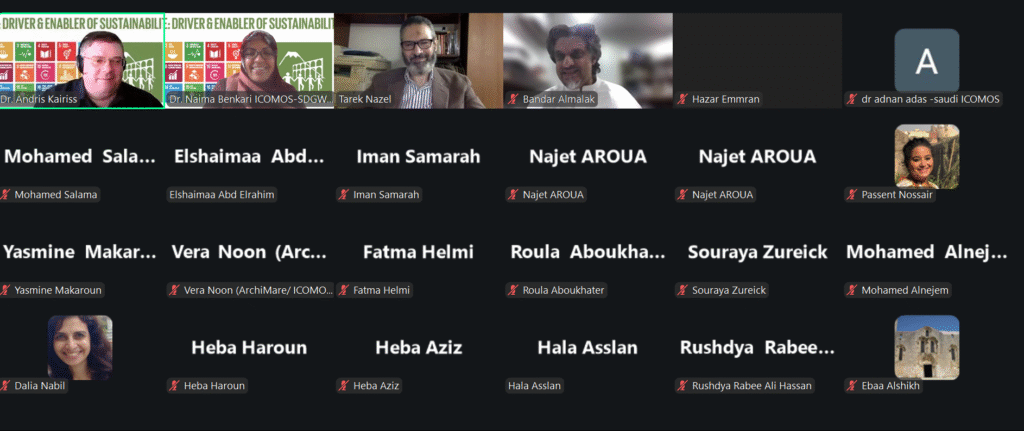
The inaugural session dedicated to the Arab Region achieved an exceptional turnout, bringing together leadership, advisory experts, and institutional stakeholders from nearly every regional NatCom to pioneer this critical shift from local action to global policy data.
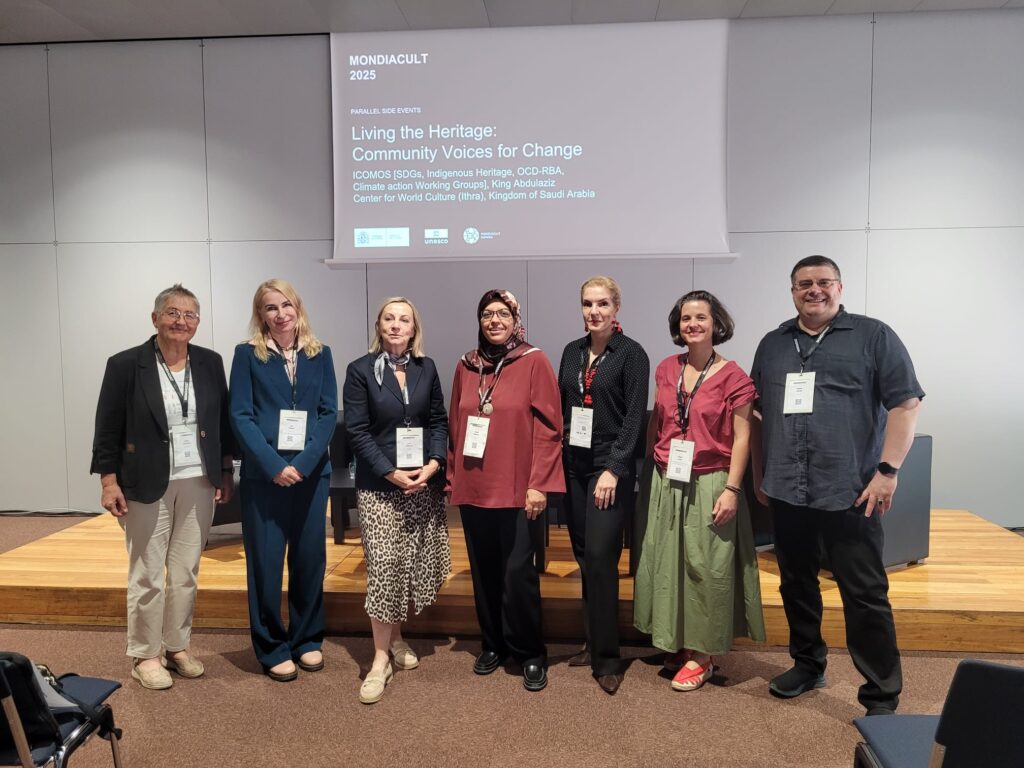
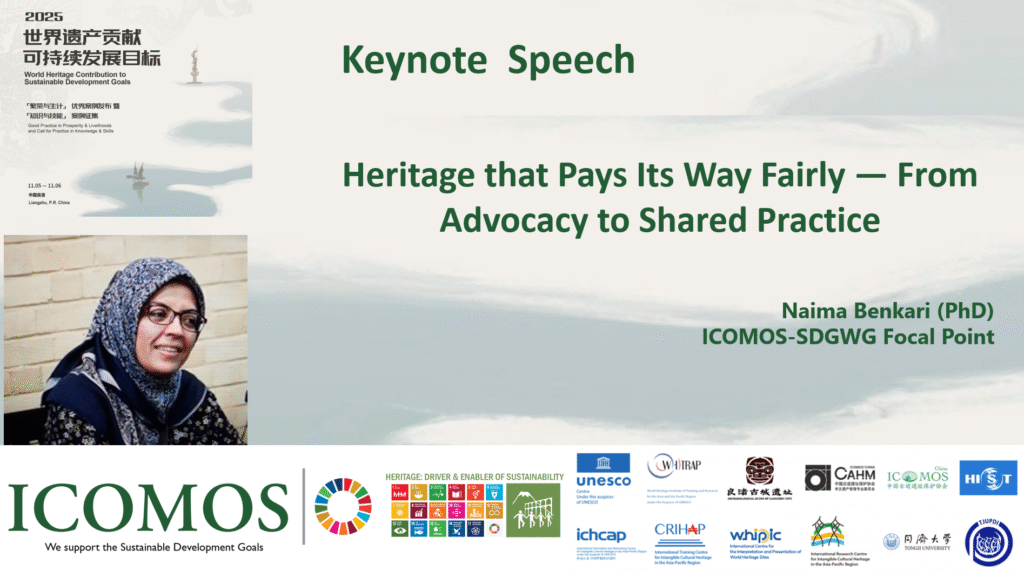
The event opened with high-level oversight and institutional openings by the ICOMOS Regional Vice President, HRH Pricess Dana Firas, who set a powerful strategic tone. Following this, SDGWG Focal Point Dr. Naima Benkari delivered a foundational address introducing the SDGWG, its diverse institutional composition, and its global mandate. She proudly introduced her dedicated working group colleagues who joined her to deliver the webinar’s technical segments, demonstrating the unified effort driving the working group’s mission.
📊 UN Strategic Briefing & Linguistic Localization
A key foundation of the webinar was delivered by UN HLPF Briefing Coordinator Olga Partina (Task Team 2 Coordinator), who detailed the mechanisms of the UN High-Level Political Forum. She underscored how unrecorded cultural data leads directly to policy invisibility, emphasizing that structured documentation is the only pathway to secure state funding. To ensure these complex global monitoring processes were fully accessible to all regional participants, the session was seamlessly localized through the Arabic translation and technical support of Prof. Tarek Nazel, breaking down technical UN terminology into actionable regional insights.
To operationalize this strategy, the SDGWG Task Teams unveiled a dual technical toolkit:
- The Mapping Template (Task Team 3): Masterfully designed and presented by Dr. Andris Kairiss (Coordinator of Task Team 3), this fillable tool extracts practical project facts, outputs, and community outcomes, linking them directly to priority SDGs.
- The Structural Framework (Task Team 3): A 7-part drafting layout that organizes scattered project evidence into a concise, report-ready subchapter for UN reviewers.
⚡ Live Insights & Strategic Advocacy
The interactive segment showcased immediate regional readiness to move from awareness to action. Regional representatives engaged in active dialogue and committed to integrating the Mapping Template directly into higher education curricula to train the next generation of heritage professionals in development-policy language.
Crucial leadership guidance from the floor emphasized maintaining strict coordination across committees to keep national reporting streamlined, practical, and focused on high-level policy impact.
With Saudi Arabia set to host the landmark MONDIACULT 2027 conference, Arab NatComs are actively mobilizing. By establishing local coordination cells to integrate these subchapters into upcoming Voluntary National Reviews (VNRs), the region is pioneering an evidence-backed global case to champion a standalone #Culture2030Goal.
🔗 Access the Tools & Get Involved:
- Download the Toolkit: icomossdgwg.com/mapping-heritage/
- Contact: Dr. Naima Benkari, SDGWG Focal Point (naima.benkari@icomos.org)
#ICOMOS #SDGWG #Culture2030Goal #SustainableDevelopment #ArabRegion #SDGLocalization #VNR #MONDIACULT2027